June 28 Jerusalem

Today’s program was devoted to Educational Encounters—half-day field trips in Jerusalem that participants chose when we registered for the Community Leadership Program. The options included:
On the Seam Line with Rana Fahoum
Processing the Holocaust with Yossi Klein Halevi
Civic Life, Activism, and Democratic Culture with Ronit Heyd
The Ministry of Foreign Affairs with Tal Becker
Holy Architecture in the City of God with Yehuda Kurtzer
In case our first choice was unavailable, we were asked to select two. Tough choices, right?
Not for me. I immediately jumped at the chance to spend several hours with Tal Becker, and was crestfallen that I was instead assigned to my second-choice group, led by Ronit Heyd. The same thing happened to Jeff, who had chosen the same options. But he was not disappointed. Jeff makes the best of every situation. He told me he had been with Tal Becker so many times that it didn’t really matter. If only I could say the same!
What I deeply value about Tal is his ability to hold the full complexity of a situation without polarizing against any position, while still following a moral compass that doesn’t reflexively treat all options as equal. In other words, he is an integral thinker, not a moral relativist or a tribal partisan.
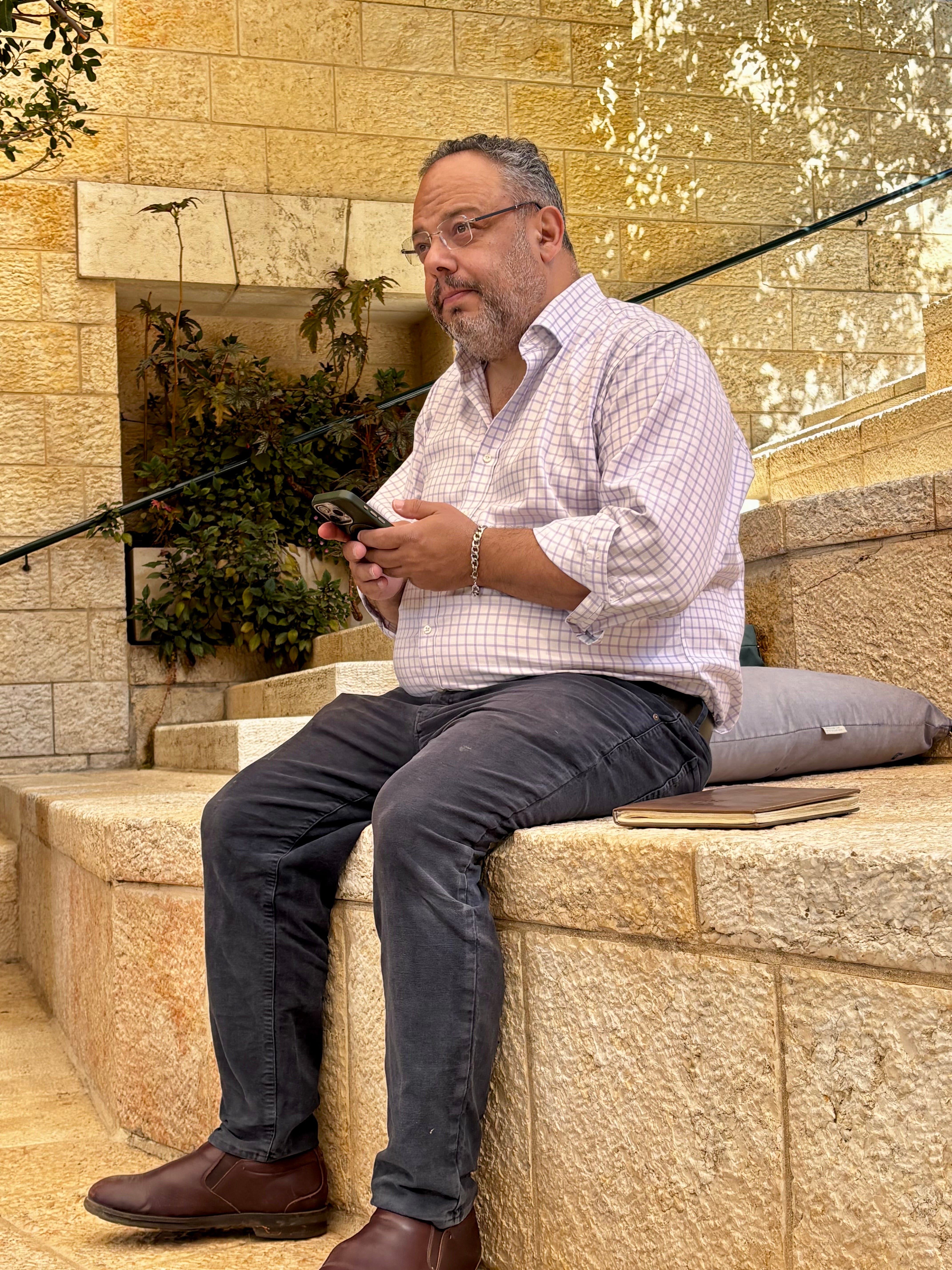
I aspire to cultivate that capacity, which I believe is sorely needed in our world—and especially in Israel today. I have not met anyone in Jewish public life or the world of Israeli advocacy who embodies this approach with Tal’s brilliance and clarity.
Ronit’s group was actually quite enjoyable. A native Jerusalemite, she adores the city, and took us to two places she treasures for the memories they hold and the past, present, and future associations they evoke. We began at the lookout point near the Montefiore Windmill, close to the neighborhood where she grew up.


Next we went to Ein Karem, the area where she now lives. We saw the wadi, a darling baby, and a beautiful Russian church.


She also took us to the 400-year-old home of her husband’s best friend, who discovered a 2,000-year-old mikvah beneath his living room floor during renovations.


Along the way, Ronit wove together ancient and modern Israeli history, current Jerusalem politics, and discussions of activism. Though I found myself to the center or right of many of her stances—not to mention those of an activist colleague she invited to join us, who blocks roads in Jerusalem to draw attention to issues she holds dear—I enjoyed both of them so much as human beings that as we said our goodbyes, I felt open and appreciative of our time together. It was a relaxing, lovely day.
PS: If you haven’t read How to Punish a Zionist, I suggest checking it out.